Hi-Fi Weather
The weather as a calm early-80s hi-fi receiver, for TRMNL e-paper displays. This is the real plugin running in your browser: pick a day, a device and your settings, or look at the weather where you are.
What it shows
- Dials on the TRMNL X: a barometer with the pressure trend, a temperature dial with today's low and high.
- Console: the temperature in segment digits, and what to wear: parka, jacket, sweater or T-shirt, and an umbrella.
- Meters for wind and gusts, UV, air quality, humidity, pollen and pressure, only when they matter.
- Rain or sun: an hour calendar when rain is coming, otherwise sunrise, sunset and the moon as seen from your place.
- Bottom strip: the coming hours, or the coming days as a week display (Blocks or Digital).
- Indoor sensor: a TRMNL temperature sensor on this screen or on another TRMNL, with an optional label; the CO2 meter shows when the source gives a CO2 reading.
- Every view: full, half horizontal, half vertical, quadrant; 1-bit, greyscale and colour screens; dark mode.
- Offline: when Open-Meteo is slow or down, the last saved forecast shows with its time.
Guide: every part of the screen
Four real screens from this page (TRMNL X, full view). Numbers match the lists. Values come from the plugin's code; yellow and red show on colour screens only, on the others count the blocks.
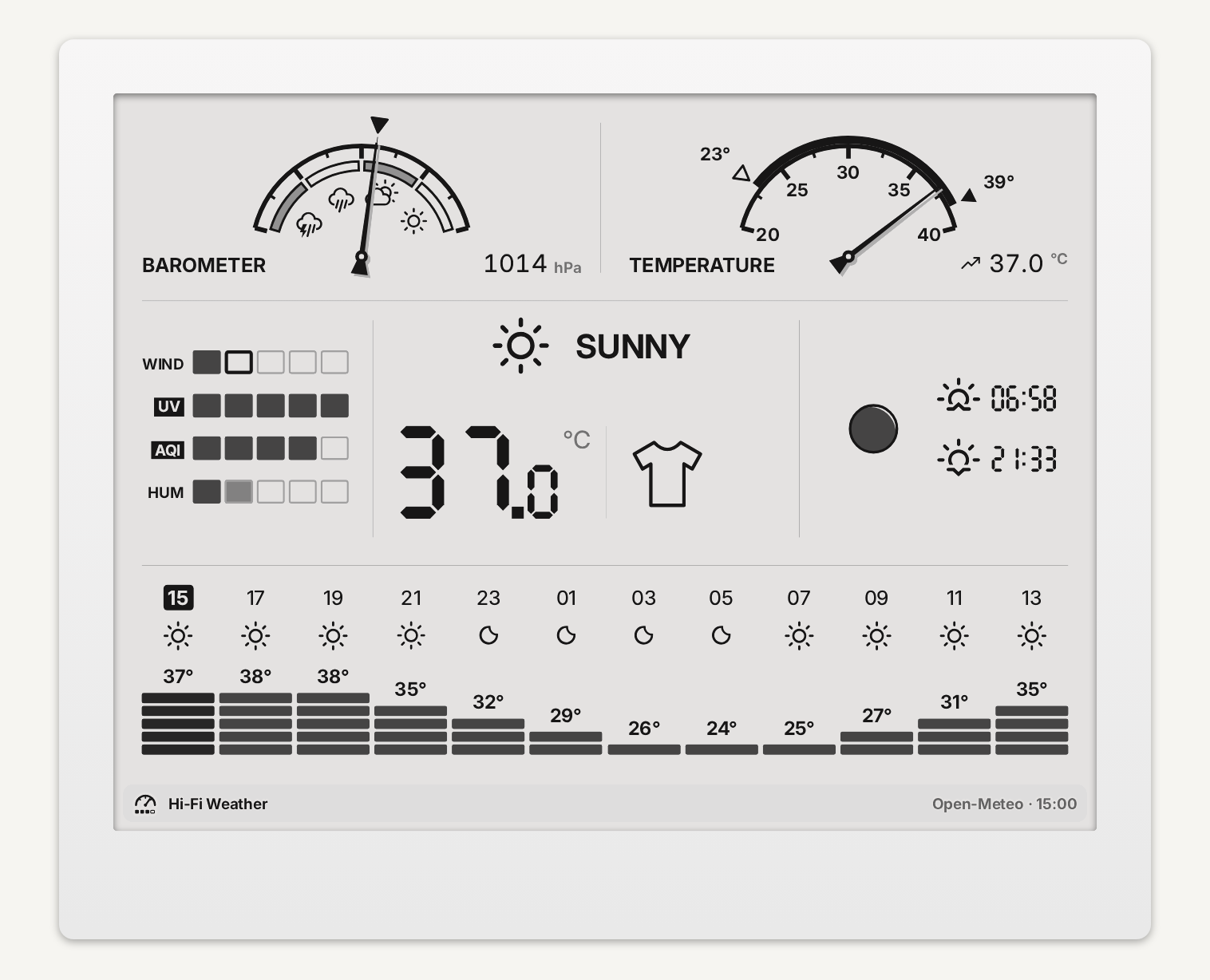
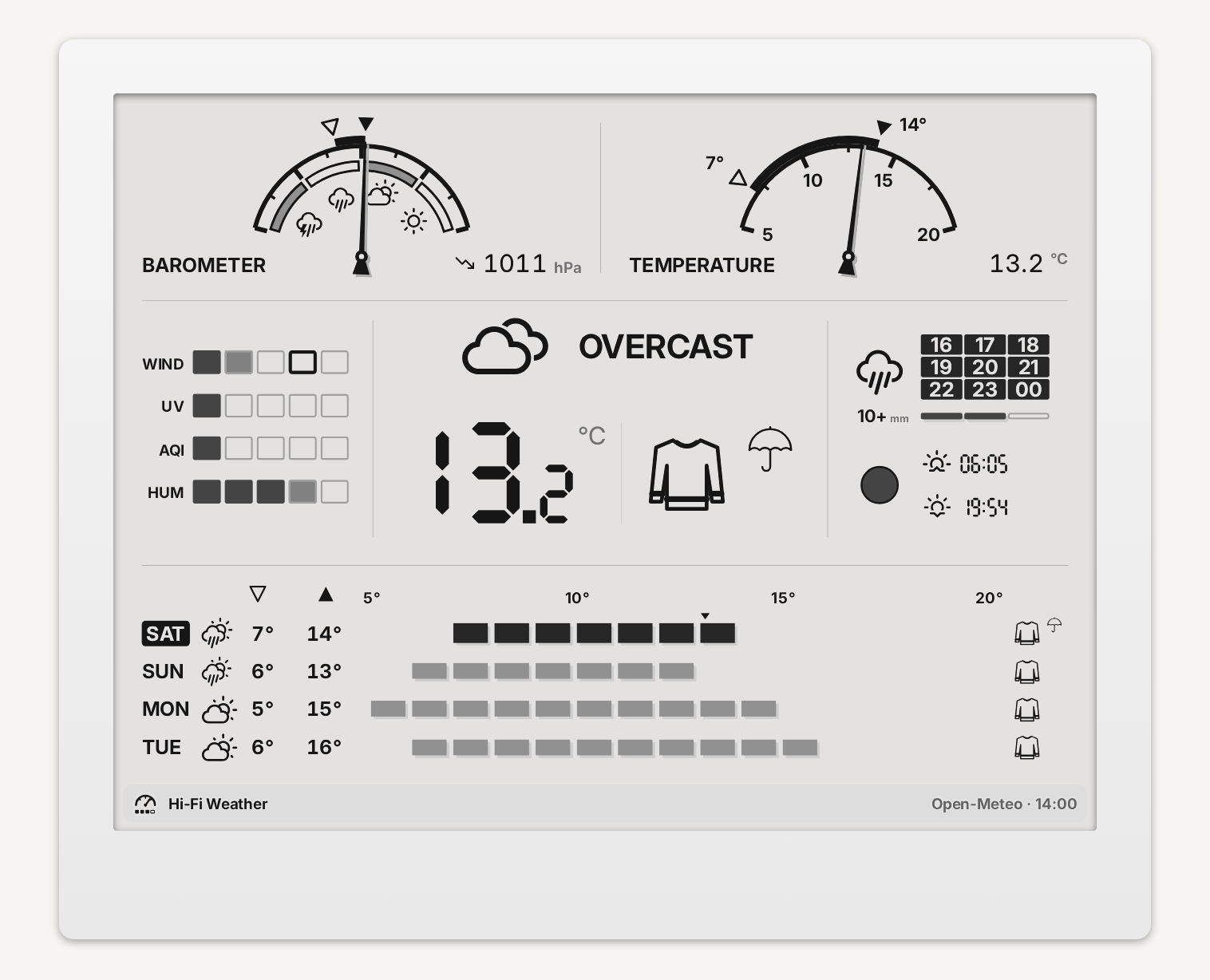
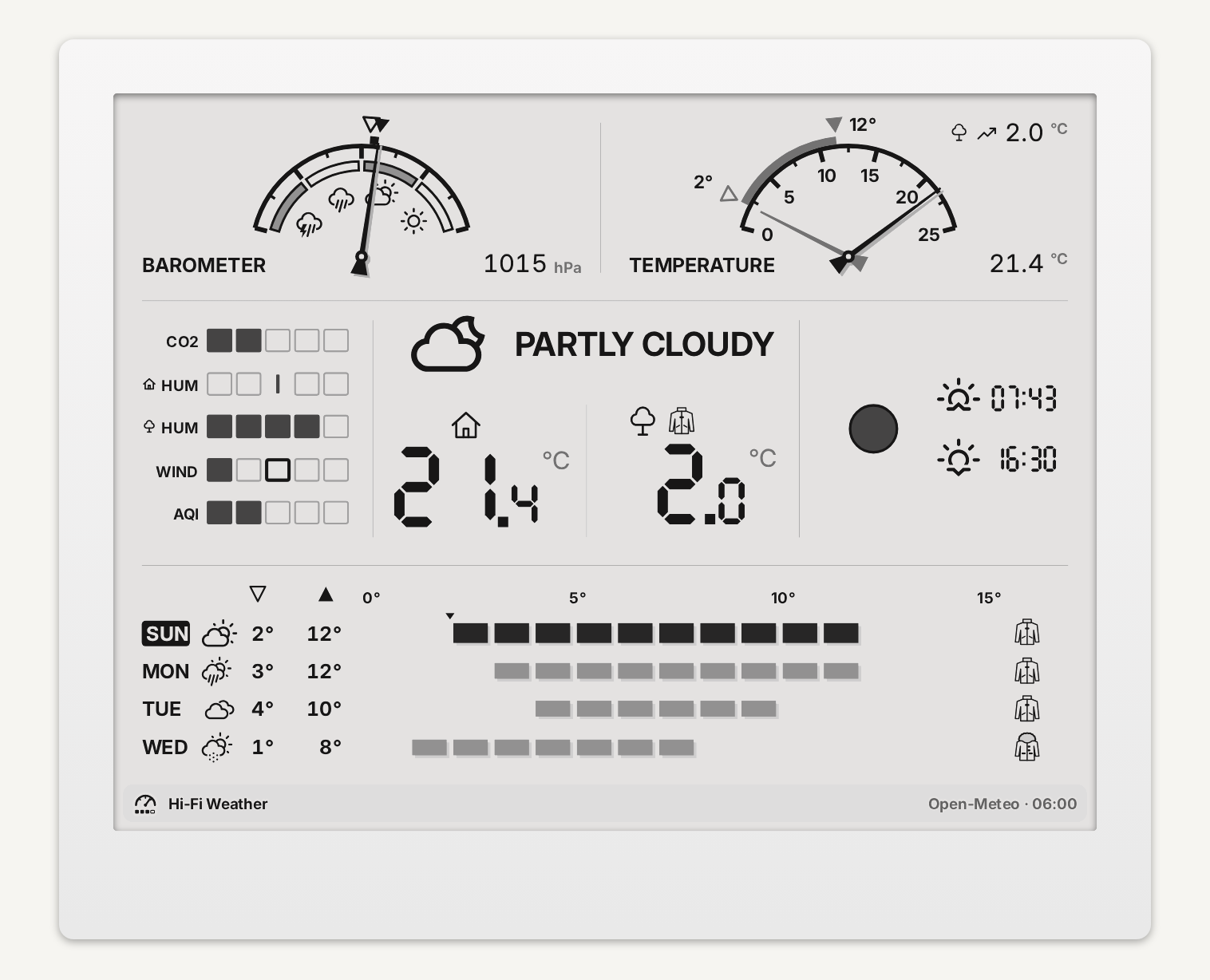
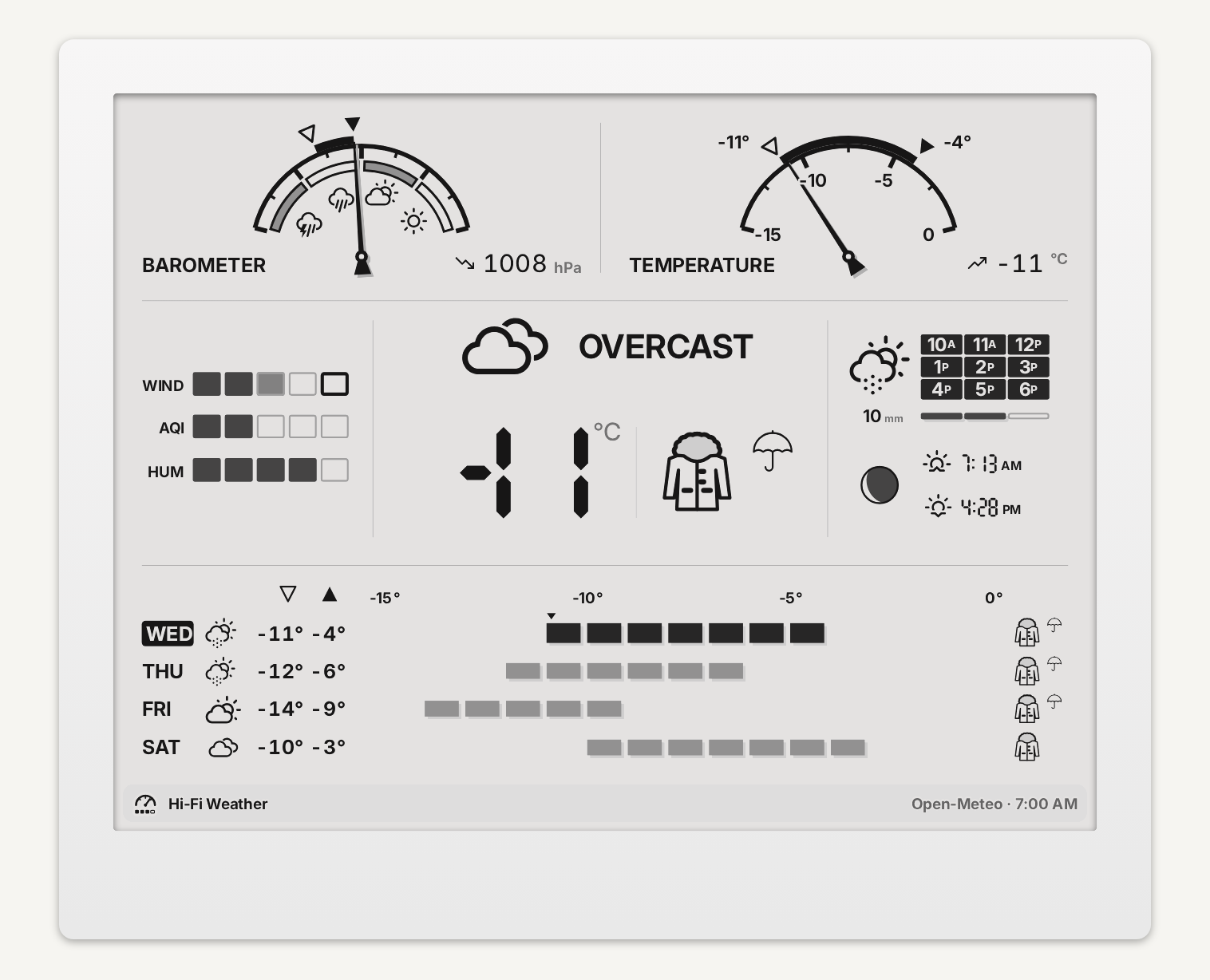
The meters, band by band
A block is yellow when its centre is in the warning zone, red in the alarming zone. A meter has 10 blocks (5 on small screens); the full meter is the whole scale. Wind and rain follow your unit setting.
| Meter | Full meter | Good | Warning (yellow) | Alarming (red) |
|---|---|---|---|---|
| WIND | 0 to 60 km/h (0 to 40 mph) | under 30 km/h (20 mph) | 30 to 50 km/h (20 to 30 mph) | over 50 km/h (30 mph) |
| UV | UV index 0 to 11 | under 3 (low) | 3 to 7 (moderate, high) | 8 and up (very high, extreme) |
| AQI | European AQI 0 to 100 | under 40 (good, fair) | 40 to 60 (moderate) | over 60 (poor, very poor, extremely poor) |
| HUM | 0 to 100 % relative humidity | A plain reading, no bands. | ||
| POLLEN | grains per m3 of the strongest of grass, birch, alder, mugwort, olive, ragweed | under 10 (low) | 10 to 50 (moderate) | over 50 (high; very high from 150) |
| BARO | 970 to 1050 hPa | No bands. About 1013 hPa is normal; the dial shows the weather zones. | ||
| CO2 | 400 to 2000 ppm (indoor sensor) | under 1000 ppm | 1000 to 1400 ppm | over 1400 ppm |
| RAIN | 3 blocks, mm per hour | 1 block: drizzle, under 1 | 2 blocks: rain, from 1 | 3 blocks: heavy rain, from 4 |
Sources: UV bands from the WHO, air quality from the European scale as served by Open-Meteo (European Environment Agency bands), pollen grains per m3 as Open-Meteo reports them. The wind and CO2 lines are this plugin's own, not an official standard.
Other views and dark mode
- Half horizontal: the console only (meters, condition, digits, cue, rain or sun), no dials and no bottom strip. Half vertical: digits, cue, rain calendar, two meters and the hours strip. Quadrant: digits, the rain calendar or the sun, and one meter. The OG has no dials and uses 5-block meters. Everything above reads the same.
- Dark mode: the same screen in white on black; greys and the grey needle keep their meaning.
Settings
| Location | City, postal code or latitude,longitude. |
|---|---|
| Temperature unit | Celsius or Fahrenheit. Wind, rain and pressure follow. |
| Time format | 24 hours (17:00) or 12 hours (5:00 PM). |
| Bottom strip | Days, hours, or hours then days. |
| Switch to days at | With Hours, then days: the hour (12:00 to 23:00, default 18:00) the hours give way to the days. |
| Sensor icon | The icon in front of the sensor's reading: a house (default) or an anemometer, a mast with cups, for a sensor outside. Only the icon changes. |
| Week display | Blocks (default: one row per day with a bar of blocks) or Digital (the high and low in segment digits). An older saved value shows Blocks. |
| What to wear | On by default. Off hides the clothing and umbrella icons everywhere. |
| Hide title bar | Hides the bar with the plugin name and update time on the full view. |
| Sensor | None (outside weather only), This TRMNL, Another TRMNL, or a provider: Home Assistant, Awair, AirGradient, Sensibo, Ecowitt, Adafruit IO or a JSON link. Readings older than 3 hours are ignored. See Indoor sensor sources below. On this page: "Sensor on" and "Sensor". |
| Sensor from another TRMNL | Shows for Another TRMNL only: the digits in the address of its page on trmnl.com. Empty or not found: this TRMNL's own sensor. |
| Sensor name | Optional short name, for example Upstairs, next to the sensor's icon and on the temperature dial. |
| Main reading | Which reading comes first: Automatic, Sensor or Outside. The other follows beside it. |
The language follows your TRMNL account language (English, German, French, Spanish, Dutch, Japanese and the languages TRMNL translates).
Indoor sensor sources
Set Sensor to a provider and fill in the fields that show. The reading takes the place of a TRMNL sensor: same icon (Sensor icon), name, main reading and CO2 meter (shown when the source gives CO2). TRMNL fetches it from the cloud, so the source must be reachable from the internet. Tokens go in password fields and are only sent to the provider. A reading older than 3 hours is ignored; when the source fails, the last good reading stays for up to 3 hours and the bottom bar says SENSOR OFFLINE with its time.
Beta = built from the provider's API docs, not yet confirmed with a real device; tell us if one fails.
| Home Assistant | Tested. Address of your Home Assistant from the internet (https://, for example Nabu Casa or a Cloudflare tunnel; a local address does not work), a long-lived access token (your profile, Security), the entity ids for temperature, humidity and CO2 (humidity and CO2 optional). Fahrenheit entities are converted. API. |
|---|---|
| Awair | Beta. Access token from the Awair Developer Console. Device type and id are optional (empty: your first Awair). The free tier allows 300 readings per device per day. API. |
| AirGradient | Beta. Token of your place (app.airgradient.com, Settings, Place). Location id optional (empty: the first indoor monitor). API. |
| Sensibo | Beta. API key from home.sensibo.com/me/api. Device id optional (empty: your first device with a reading). Temperature and humidity only. Unit assumed Celsius. API. |
| Ecowitt | Beta. Application key and API key from ecowitt.net (API management) and the MAC of the station. Indoor temperature, humidity and, with a CO2 sensor, CO2. API. |
| Adafruit IO | Beta. Username, active key, and the feed key for each reading (temperature required), plus the unit the temperature feed uses. API. |
| Custom link (JSON) | Beta. Any https:// link that answers JSON: optional header name and token, a dot path for each reading (data.rooms.0.temp), optional time path, the temperature unit. |